VIDEO · 2026
Why there's no warning before the breakthrough: the 59.27% tipping point
A ~6-minute math animation (Chinese narration) with a full write-up. Some say effort below the tipping point means nothing. I fill a 1,000-square sheet of graph paper at random and pour water in from the top: at square 592, all 25 rows light up at once. Then I simulate many sheets to find the 59.27% cliff and check how much of the saying holds.
Chinese narration · 720p · captions track (zh) · MP4
Article: testing the "tipping point" saying on 1,000 squares of graph paper
There is a saying that gets passed around a lot: effort that doesn't cross the tipping point means nothing. It sounds harsh, and it is hard to argue with, because a "tipping point" looks like a line nobody can get around.
I wanted to look at it another way. Mathematics happens to have a model built for exactly the question "when does everything suddenly connect?" It is called percolation. It is simple enough to show on a sheet of graph paper, and easy to hand to a computer to simulate again and again. This article is the written version of the video: first we watch one sheet of 1,000 squares connect, then we fill many sheets to find the tipping point, and finally we go back to the saying and check how much of it holds. The data come from my own computer simulations; the value of the tipping point is taken from Jacobsen's 2015 calculation.
1. A sheet of 1,000 squares
The rules are short. The sheet has exactly 1,000 squares, 25 rows from top to bottom. We fill the squares one by one in random order. Two filled squares touching up, down, left or right count as linked; squares touching only diagonally do not.
If linked squares run all the way from the top row to the bottom row, the sheet is connected. To make that visible, we pour water in from the top. Water can only flow through linked squares, and every square it reaches lights up.
At 30% filled, the water lights up 4 rows from the top. At 40%, it reaches row 5. At half filled, only row 7. At 58%, it reaches row 9, and the sheet is still not connected.

So far, the harsh saying seems right: most of the sheet is filled, and the water still can't get through.
2. Square number 592
We keep filling. When square 592 goes in, the whole sheet suddenly connects. One more square, and all 25 rows light up at once.

Which raises the question: were the 591 squares filled before that path appeared wasted?
3. Before it connects, the biggest clump keeps growing
Rewind to when only half the sheet was filled. Linked squares form separate clumps, and the biggest one has just 50-odd squares. Keep filling, and it grows past 200. One square short of connecting, it already has over 400 squares, more than 70% of all filled squares, and it still doesn't connect.

The trouble is that none of this shows from the outside. At the moment it is closest to connecting, the water from the top also stops halfway. It looks no different from when it was farthest away.
Square 592 connects only because all the earlier squares are already there. Put the same square on a half-filled sheet and it links to nothing. After the sheet connects, things move even faster: the biggest clump soon holds nearly 90% of the filled squares.
4. The cliff stands at 59.27%
Of course, square 592 might just be this sheet's luck. So I had a computer fill many sheets of different sizes over and over, counting how often each one was already connected at a given fill level.
On small sheets, the chance of connecting rises slowly. At 58% filled, about 40-odd runs out of 100 are already connected. On very large sheets filled to the same level, only 7 out of 100 connect. Fill the large sheets to 62%, and they connect top to bottom every single time.
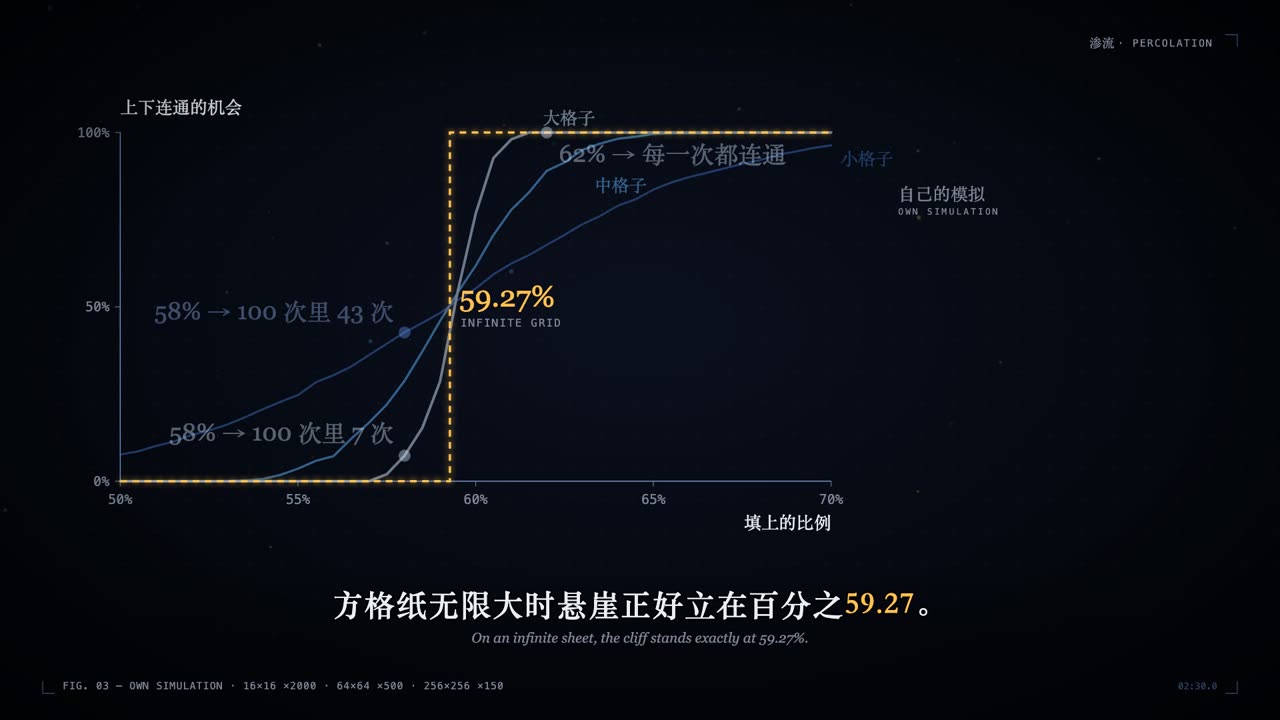
The bigger the sheet, the more this curve looks like a cliff. On an infinite sheet, the cliff stands at about 59.27%: below it, the sheet never connects; above it, it always does. That spot is the tipping point, the one the saying is talking about.
5. The tipping point lives in the network
So if the network changes shape, does the cliff stay put? It doesn't.
Square cells link only to their 4 neighbors, and the tipping point is 59.27%. On a triangular grid, each cell has 6 neighbors, and the tipping point drops to exactly half. Stack the squares into cubes, where each cell also has 6 neighbors, and it falls to about 31%. The rules haven't changed at all, yet cubes need nearly half as much filling.

So the tipping point isn't in you. It lives in the network you're standing on. At half filled, the cubes have long since connected while the square grid still can't.
6. The saying is only half right
Back to the start: is effort below the tipping point really meaningless? My answer is that the saying is only half right.
The true half: an infinite square grid that isn't filled to the tipping point never connects.
The wrong half: even before it connects, the biggest clump keeps growing, and just before connecting it has over 400 squares. And real networks are always finite. The small sheets above connected 40-odd times out of 100 before reaching the tipping point.
One caveat matters, though: your life is not graph paper. The squares on the sheet are filled at random; your effort is not random. So 59.27% can't be applied to you directly. What the graph paper can lend you is only this shape: before the tipping point, you can't see the change; past it, everything suddenly links up.

You may have heard the line that many of life's failures are people who didn't realize how close they were to success when they gave up. One square short, the water still stops at row 9, looking much the same as at half filled. Effort before the tipping point isn't meaningless. It just can't be seen yet. So don't give up while it's still invisible.
7. An aside: from gas masks to forest fires
That answers the saying. Here are a few unrelated things I find fun.
The critical fraction for the square grid is about 59.27%, but nobody has ever found an exact formula for it. Mathematicians can only close in on it by computer, and they have pinned it down to fourteen decimal places.
The model began with coal miners' gas masks. The carbon granules in a mask are full of tiny pores that link into a maze. If the pores link well enough, gas can seep deep inside and get absorbed; if not, it stays at the surface, just like the water stopping at row 9. In 1957, the British researchers Broadbent and Hammersley turned the problem into a mathematical model and named it percolation, as in water slowly seeping through coffee grounds.

Physicists call this kind of sudden change a phase transition; water freezing at zero degrees is one, too. When trees grow densely enough, a spark can burn through the whole forest. When people are in close enough contact, a disease can spread through the crowd. When the cracks in underground rock link up, the oil inside can flow out.

Forest rangers and vaccinators want the network to stay disconnected; you want yours to connect. The closer the sheet gets to the tipping point, the more a single square decides whether it connects at all. The squares you've already filled have pushed you to the edge of the cliff. The sheet is waiting for your square 592.
Data: my own computer simulations; the tipping-point value is from Jacobsen (2015). Origin of the model: Broadbent & Hammersley (1957).
The video (Chinese narration) is also on Bilibili.